
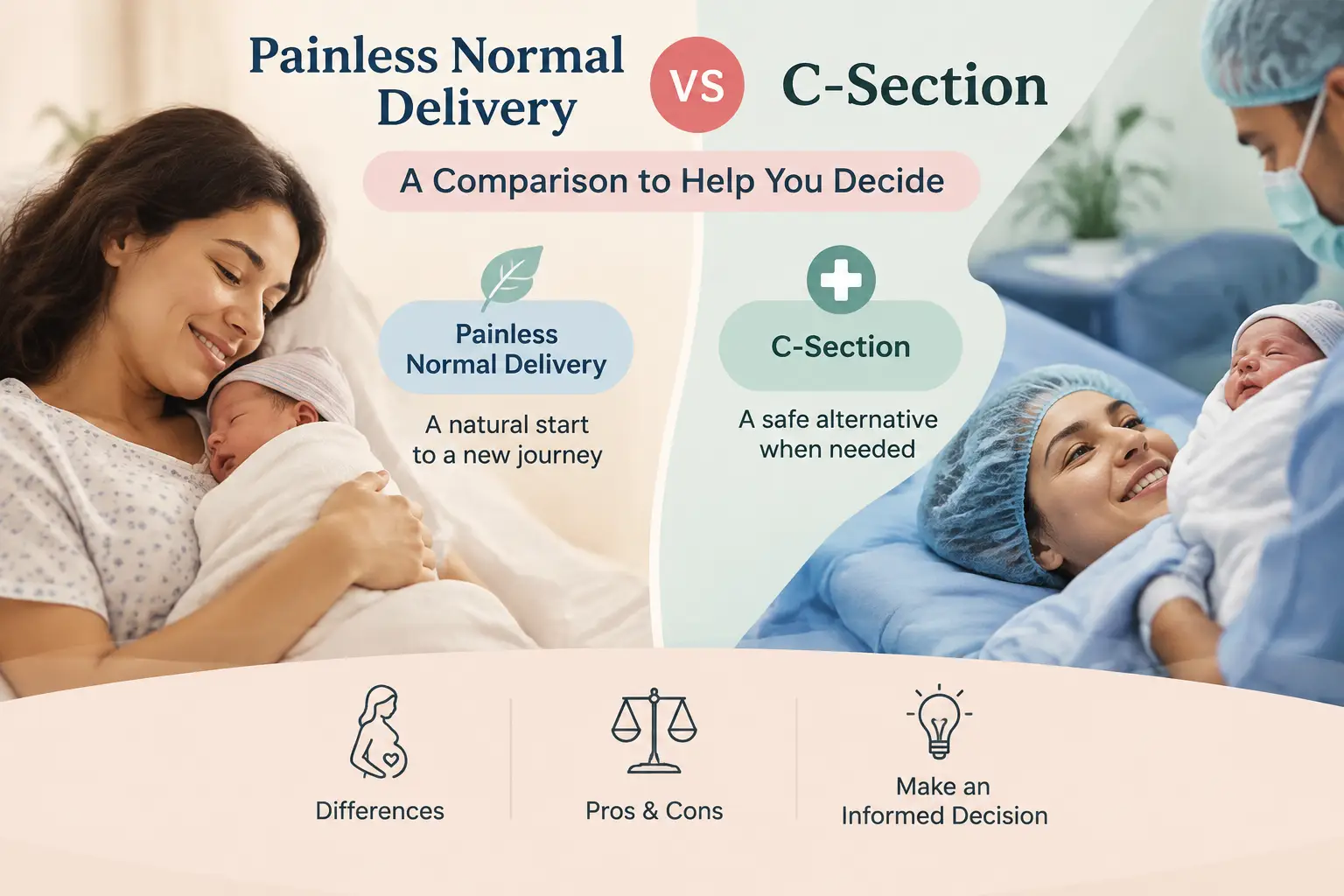
Choosing between a painless normal delivery and a C-section is one of the most significant decisions an expecting mother will make — and it's rarely a simple either/or choice. It depends on your health history, how your pregnancy is progressing, your baby's position, and factors that only become clear as delivery approaches.
"There's no universally 'better' option between the two. Both are safe, well-established delivery methods, and the right choice depends entirely on the individual mother and baby," says Dr. Pallab Roy, a gynaecologist with extensive experience in maternal and obstetric care. This blog breaks down both methods in detail — including what actually happens during each, the real risks and benefits, recovery timelines, and the factors your doctor will weigh before recommending one over the other.
Disclaimer: This article is intended for general informational purposes only and does not replace professional medical advice. Every pregnancy is different — always consult your gynaecologist to determine the safest delivery method for your specific condition.
Understanding Painless Normal Delivery
A painless normal delivery is a vaginal birth in which epidural anaesthesia is used to manage labour pain. The biological process of labour and delivery remains the same as a traditional vaginal birth — the epidural simply blocks pain signals from the lower body, allowing the mother to stay alert and involved throughout delivery without the intensity of contraction pain.
How the Epidural Works
An anaesthesiologist administers the epidural through a thin catheter placed in the lower back. It typically takes effect within 10–20 minutes and can be adjusted throughout labour, giving the mother pain relief while still allowing her to push effectively during the final stage.
Pros of Painless Normal Delivery
- Faster recovery — Most women resume light daily activity within a few days, compared to weeks for surgical recovery.
- Lower risk of surgical complications — No incision means a reduced risk of infection, blood clots, or anaesthesia-related surgical complications.
- Immune system benefits for the baby — Babies born vaginally are exposed to beneficial maternal bacteria during birth, which some research links to early immune system development.
- Shorter hospital stay — Typically 1–2 days, versus 3–5 days for a C-section.
- Pain relief without losing the natural birthing process — The epidural manages pain, but the mother still experiences vaginal delivery and its associated recovery advantages.
Cons of Painless Normal Delivery
- Labour pain before the epidural takes effect — Early labour contractions are still felt until the epidural is administered.
- Not suitable for every pregnancy — If the baby is in distress, in a breech position, or there are certain maternal health complications, normal delivery may not be medically advisable.
- Possible perineal tearing — Some women experience minor to moderate vaginal tearing during delivery, which usually heals within a few weeks.
- Epidural side effects — A small number of women experience temporary side effects like a drop in blood pressure, mild headache, or soreness at the injection site.
Understanding C-Section (Cesarean Delivery)
A C-section is a surgical procedure in which the baby is delivered through an incision made in the mother's abdomen and uterus. It may be planned due to a known medical condition, or performed as an emergency procedure if complications arise unexpectedly during labour.
Pros of C-Section
- No labour pain during delivery — The procedure is performed under regional or general anaesthesia, so the mother feels no pain during the birth itself.
- Predictable timing — A planned C-section allows the delivery date to be scheduled, which can matter for medical monitoring or family planning.
- Safer option in high-risk pregnancies — Conditions such as placenta previa, a narrow pelvis, breech position, twin/multiple pregnancies, or certain maternal health conditions often make C-section the medically safer route.
- Reduces certain risks to the baby — In situations of foetal distress or complicated positioning, a C-section can prevent birth injury or oxygen deprivation.
Cons of C-Section
- Longer recovery time — As major abdominal surgery, recovery typically takes 4–6 weeks, with restricted movement and soreness in the early days.
- Higher risk of infection — Like any surgery, there's a risk of wound infection, blood clots, or reaction to anaesthesia.
- Impact on future pregnancies — Multiple C-sections can increase the risk of complications such as placenta previa, placenta accreta, or uterine rupture in later pregnancies.
- Delayed bonding and mobility — Some mothers experience delayed skin-to-skin contact and reduced early mobility compared to vaginal birth.
Painless Normal Delivery vs C-Section: Side-by-Side Comparison
| Factor | Painless Normal Delivery | C-Section |
|---|---|---|
| Pain during delivery | Managed with epidural | No pain (anaesthesia-controlled) |
| Recovery time | Few days to 1–2 weeks | 4–6 weeks |
| Hospital stay | 1–2 days | 3–5 days |
| Risk of infection | Lower | Higher (surgical risk) |
| Scarring | None | Abdominal scar |
| Impact on future pregnancies | Minimal | Higher risk with repeat C-sections |
| Suitability | Low-risk, uncomplicated pregnancies | High-risk pregnancies, medical necessity, or emergencies |
| Predictability | Depends on natural labour onset | Can be scheduled in advance |
What Determines Which Delivery Method Is Right for You?
There's no one-size-fits-all answer. According to Dr. Pallab Roy, a gynaecologist will typically evaluate several factors before recommending a delivery method:
- The baby's position — Head-down (cephalic) positioning generally supports vaginal delivery; breech positioning often requires a C-section.
- Baby's size relative to the mother's pelvis — A significant size mismatch may make vaginal delivery unsafe.
- Existing health conditions — Gestational diabetes, hypertension, or pre-eclampsia can influence the safest delivery route.
- Previous delivery history — A prior C-section doesn't automatically rule out a vaginal birth in a later pregnancy (this is known as VBAC — vaginal birth after cesarean), but it requires careful medical evaluation.
- Progress of labour — Some pregnancies that begin as planned vaginal deliveries may need to shift to an emergency C-section if complications arise during labour.
For low-risk pregnancies, painless normal delivery is often encouraged because of its faster recovery and lower surgical risk. However, when complications are present — or arise unexpectedly — a C-section becomes the safer choice for both mother and baby.
The Most Important Takeaway
Neither delivery method is inherently "better." Each is designed to be the safest option under specific circumstances. The right decision isn't about which method sounds easier — it's about which one is medically appropriate for your pregnancy, as assessed by a qualified gynaecologist who understands your complete health history.
Frequently Asked Questions
Is painless delivery safe for the baby?
Yes. Epidural anaesthesia used in painless delivery is administered in controlled doses and is considered safe for the baby when given by trained medical professionals. It affects the mother's pain perception, not the baby's development.
Does an epidural slow down labour?
In some cases, epidurals can slightly lengthen the second stage of labour, but this varies by individual and is closely monitored by the medical team to ensure both mother and baby remain safe throughout.
Can I have a normal delivery after a previous C-section?
In many cases, yes — this is called VBAC (vaginal birth after cesarean). Eligibility depends on factors like the type of previous uterine incision, the reason for the earlier C-section, and current pregnancy conditions. This should always be evaluated by your gynaecologist.
How painful is labour with an epidural compared to without?
An epidural significantly reduces the intensity of labour pain, though some pressure sensation may still be felt during pushing. Pain before the epidural is administered is not affected.
What is the recovery time difference between normal delivery and C-section?
Normal delivery recovery generally takes a few days to two weeks for most daily activities, while C-section recovery, being major surgery, typically takes four to six weeks for full recovery.
Can a C-section be avoided if I prefer normal delivery?
If your pregnancy is low-risk and progresses without complications, a normal delivery is often possible. However, medical safety always takes priority — if complications develop during labour, a C-section may become necessary even if it wasn't the original plan.
How many C-sections can a woman safely have?
While there's no fixed universal limit, each additional C-section carries increased surgical risk. This should be discussed individually with your gynaecologist based on your health and pregnancy history.