
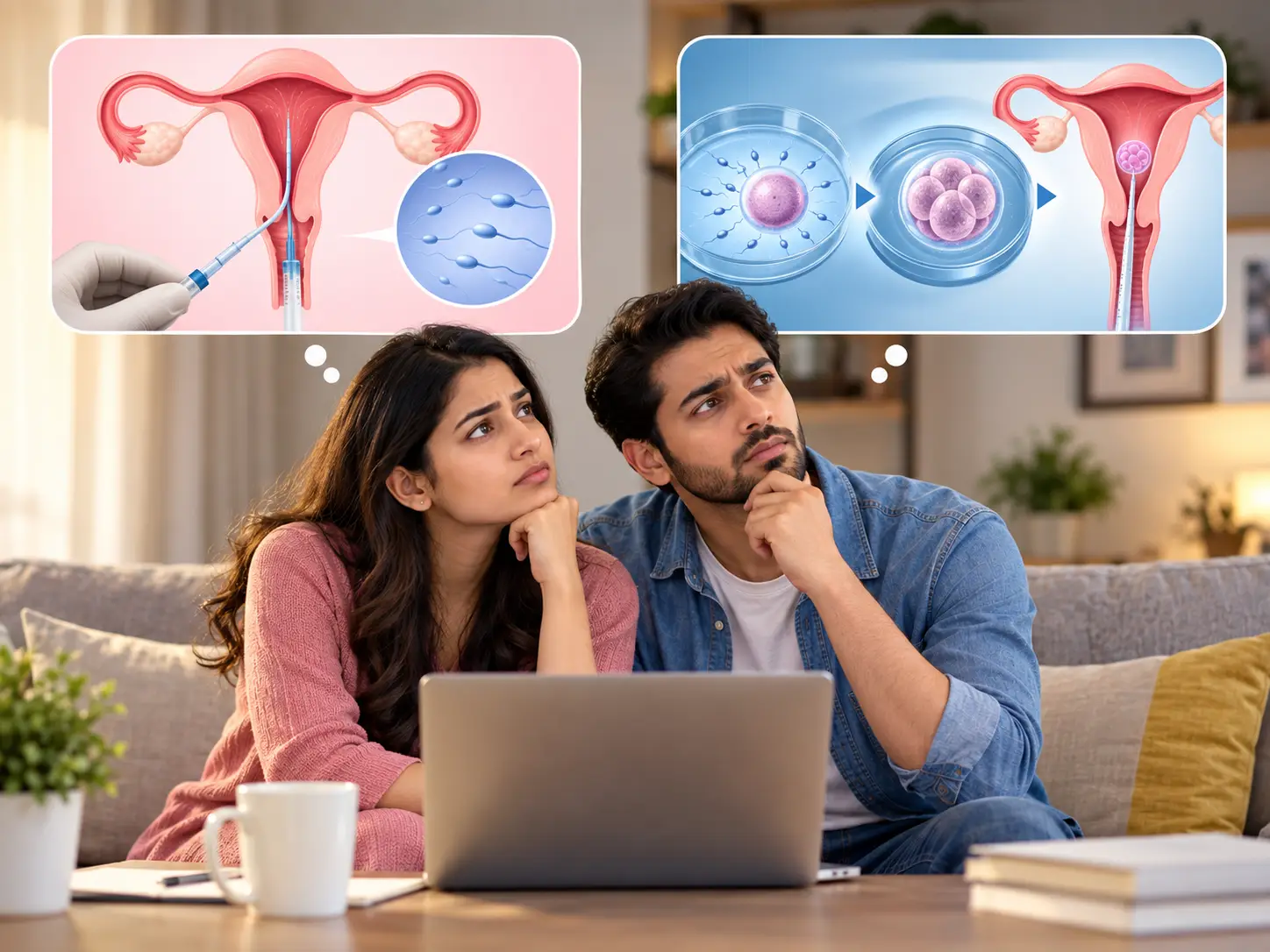
Choosing a fertility treatment can feel confusing, especially when you are deciding between two commonly used options. IUI and IVF work differently, involve different procedures, and suit different fertility situations.
This guide explains how each treatment works, who may benefit, how success rates vary, and what factors influence the choice. Dr Pallab Roy shared insights to help compile this post and help you understand your options clearly before discussing them with a specialist.
What Is IUI (Intrauterine Insemination)?
It is a fertility treatment in which prepared sperm is placed directly inside the uterus around the time of ovulation. It is also known as artificial insemination!
How Does the IUI Procedure Work?
The quick, in-office procedure involves these basic steps:
- Sperm preparation: The partner or donor provides a sample, which a lab washes to concentrate the healthiest, most active sperm.
- Ovulation tracking: The cycle is monitored via ultrasound or blood tests to pinpoint ovulation, which may occur naturally or be triggered by medication.
- Insertion: The doctor uses a thin, flexible tube to gently pass the prepared sperm through the cervix into the uterus.
- Recovery: Patients rest briefly afterwards and can return to normal daily activities immediately.
What Is IVF (In Vitro Fertilisation)?
It is a medical treatment where a woman’s egg and sperm are combined in a laboratory dish outside the body to create an embryo, which is then placed into the uterus. Unlike insemination, fertilisation takes place outside the body under controlled laboratory conditions. Because it involves several stages, it is more involved than IUI.
How Does the IVF Procedure Work?
The comprehensive process moves through five distinct stages:
- Ovarian stimulation: Injectable medications stimulate the ovaries to produce multiple mature eggs simultaneously.
- Egg retrieval: A doctor performs a minor surgical procedure to harvest the eggs using ultrasound guidance.
- Lab fertilisation: Collected eggs are mixed with sperm, or a single sperm is injected directly via ICSI.
- Embryo culture: Fertilised eggs grow in a monitored incubator for several days to become embryos.
- Embryo transfer: One or more healthy embryos are gently placed into the uterus to achieve pregnancy.
What Is the Difference Between IUI and IVF?
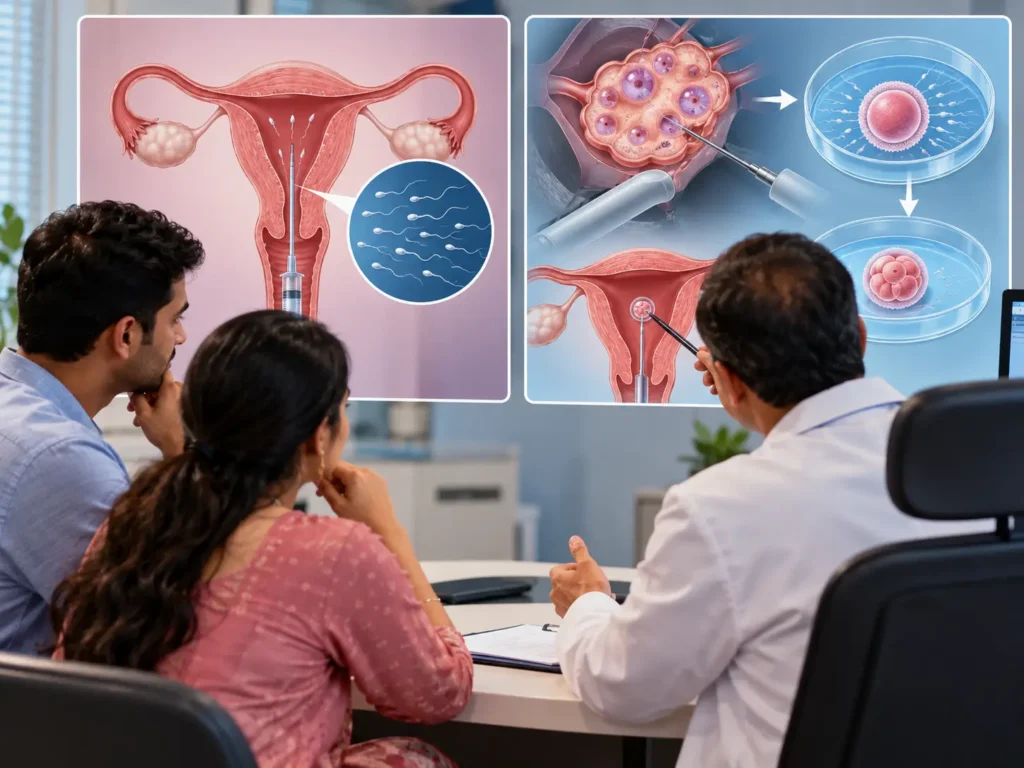
While both are effective fertility treatments, IUI is a simpler procedure that places sperm inside the uterus, whereas IVF is a multi-stage process that fertilises the egg outside the body in a laboratory.
| Feature | Intrauterine Insemination | In Vitro Fertilisation |
| Invasiveness | Low; a thin catheter is used to place prepared sperm into the uterus. | Higher; involves egg retrieval, usually with sedation or anaesthesia. |
| Complexity | Simpler; mainly involves timing ovulation and placing sperm. | More complex; involves ovarian stimulation, egg retrieval, laboratory fertilisation, embryo culture and transfer. |
| Typical Visits | Fewer; monitoring needs vary by treatment cycle. | More frequent; requires monitoring throughout stimulation and subsequent treatment stages. |
| Suitability | May be considered for unexplained infertility, mild male-factor infertility or ovulation problems. | May be considered for blocked tubes, severe male-factor infertility, reduced ovarian reserve or repeated unsuccessful IUI. |
Understand our approach to infertility evaluation and care.
Who Is a Good Candidate for IUI?
Intrauterine insemination is ideal for individuals with at least one open fallopian tube and healthy uterine function. Doctors typically recommend it first for:
- Unexplained infertility: Conception struggles without a clear medical cause.
- Mild male-factor infertility: Lower sperm count or slight motility issues.
- Ovulation disorders: Irregular cycles that need medication and precise timing.
- Cervical factors: Mucus that prevents sperm from travelling effectively.
- Donor sperm users: Single women, LGBTQ+ couples, or couples with severe male infertility.
Who Is a Good Candidate for IVF?
In vitro fertilisation is generally the preferred starting point for complex fertility barriers that require direct laboratory intervention. It is highly recommended for:
- Blocked fallopian tubes: Structural damage or complete blockage preventing natural fertilisation.
- Severe male infertility: Very low sperm count, poor shape, or movement issues.
- Advanced maternal age: Decreased egg quality or diminished ovarian reserve.
- Severe endometriosis: Tissue growth affecting pelvic organs and egg quality.
- Failed treatments: Unsuccessful outcomes after multiple repeated IUI cycles.
Read more on the role of laparoscopic surgery in infertility.
What Are the Success Rates of IUI vs IVF?
IVF generally has a higher success rate per cycle than IUI, although outcomes vary with age and individual health factors. [Source].
Success Rate By Age
| Age Group | IUI Pregnancy Rate | IVF Pregnancy Rate |
| Under 30 years | 39.2% | 52.3% |
| 30–35 years | 32.8% | 45% |
| Over 35 years | 22.5% | 30% |
Overall, clinical pregnancy occurred in 33.3% of the IUI group and 46% of the IVF group. [Source].
What Are the Risks and Side Effects of IUI and IVF?
| Treatment | Common Side Effects | Potential Risks |
| IUI | Mild uterine cramping, light spotting, temporary bloating | Low risk of pelvic infection; slight risk of twins when stimulating medicines are used |
| IVF | Injection-site bruising, mood swings, breast tenderness, fatigue | Ovarian hyperstimulation syndrome (OHSS), higher risk of multiple pregnancy, and minor risks associated with egg retrieval |
How Do You Decide Which Treatment Is Right for You?
The choice depends on your unique fertility profile and personal boundaries. Your medical team will evaluate several key factors to guide your decision:
- Age and diagnosis: Advanced age or blocked tubes point to IVF, while mild ovulation or sperm issues favour IUI.
- Timeline and history: How long you have been trying and whether you have failed prior IUI cycles.
- Readiness: Your emotional, physical, and financial capacity for treatment complexity.
Make this final decision with personalised guidance from a fertility specialist. Explore our full range of gynaecology treatments!
When Should You Consult a Fertility Specialist?
- Under age 35: After 12 months of regular, unprotected intercourse without conceiving.
- Age 35 to 39: After 6 months of consistent trying.
- Age 40 or older: Immediately upon deciding to conceive.
- Known medical conditions: Right away if you have a history of PCOS, severe endometriosis, irregular cycles, or known male fertility factors.
Taking the Next Step Toward Parenthood

Both IUI and IVF have successfully helped millions of individuals and couples build their families. While the medical pathways differ in complexity and approach, the ultimate goal remains the same. Navigating these options can feel overwhelming, but you do not have to walk this path alone.
Take a confident step forward by scheduling a personalised fertility evaluation. You can book a consultation with Dr Pallab Roy, a highly trusted obstetrician-gynaecologist, offering female infertility treatment in Kolkata.
Frequently Asked Questions
How much does IUI cost compared to IVF?
Usually, the former costs less because it requires fewer medicines, procedures, and laboratory services. The latter involves additional steps such as egg collection, fertilisation, embryo development, and transfer.
How many IUI cycles should I try before moving to IVF?
There is no fixed number. Often, three or four unsuccessful attempts may prompt a change in strategy, but age, diagnosis, ovarian reserve, sperm quality, and previous results influence timing.
Is IVF painful?
No. Most people experience manageable discomfort, not severe pain. Injections can sting briefly, while egg collection is performed with sedation or anaesthesia. Mild cramping afterwards is possible.
What is the age limit for IUI and IVF treatment?
There is no single universal limit. Suitability depends on ovarian reserve, egg quality, overall health, reproductive history, sperm factors, and applicable medical or regulatory considerations.
Can IUI or IVF work for someone with PCOS?
Yes. Pregnancy may be achieved, particularly when ovulation is appropriately managed. The approach depends on age, ovarian reserve, tubal health, sperm quality, previous treatment, and individual reproductive factors.
What is the first-cycle success rate of IVF?
It varies considerably between individuals. Age, ovarian reserve, embryo quality, sperm factors, underlying diagnosis, and laboratory outcomes all affect the likelihood of achieving pregnancy on the first attempt.
How long does a full IVF cycle take, start to finish?
Typically, a full attempt takes about three to six weeks. The duration depends on medication schedules, monitoring, egg collection, embryo development, transfer timing, and individual treatment requirements.
Is IUI or IVF better for unexplained infertility?
Neither is universally preferable. The decision depends on age, duration of trying, previous attempts, ovarian reserve, sperm parameters, and other findings identified during a comprehensive fertility assessment.
Does health insurance cover fertility treatments in India?
Coverage varies between insurers and policies. Some plans exclude assisted reproduction, while others provide limited benefits subject to eligibility, waiting periods, exclusions, reimbursement rules, and specific policy conditions.
Can IUI be repeated immediately if it fails?
Yes, you may be able to start another attempt during the next menstrual cycle if there are no medical concerns. The specialist may recommend waiting or changing strategy based on individual circumstances.