

Many couples receive reassuring fertility reports, yet still struggle to conceive. While routine tests identify many common problems, they cannot detect every condition affecting reproductive health. An experienced gynaecologist can investigate beyond standard assessments to uncover hidden causes of infertility in females that routine screening may miss.
If you've been trying to conceive despite normal reports, it does not necessarily mean that nothing is wrong. Some unexplained infertility causes involve subtle hormonal, anatomical, or inflammatory changes that require specialised evaluation. Understanding these possibilities helps guide appropriate investigations and personalised treatment.
What Does It Actually Mean When Your Fertility Tests Are “Normal”?

A normal fertility report simply means routine investigations did not identify an obvious cause of infertility. It does not rule out every reproductive condition. Some abnormalities only become apparent through specialised assessments or over time, especially when pregnancy does not occur despite apparently reassuring results.
Standard fertility evaluation usually includes ovulation assessment, hormone testing, tubal patency testing (HSG), semen analysis, and ultrasound imaging. For many couples trying to conceive, normal test results can feel reassuring, but these investigations primarily detect common fertility problems rather than every possible cause.
Routine tests for unexplained infertility help exclude obvious abnormalities. However, they cannot always identify microscopic inflammation, implantation disorders, mild hormonal fluctuations, or subtle pelvic disease that may reduce fertility despite otherwise normal findings.
Why Do Standard Tests Miss So Much?
Routine fertility investigations are designed to detect common reproductive disorders, but they cannot evaluate every biological process involved in conception. Many fertility problems develop gradually, occur intermittently, or require specialised investigations beyond standard screening.
Most fertility investigations provide a snapshot of reproductive health rather than continuous monitoring. Hormone levels fluctuate throughout the menstrual cycle, while ultrasound scans may not reveal early endometriosis, microscopic inflammation, or functional abnormalities affecting implantation.
Although standard tests for unexplained infertility eliminate many common conditions, they may not identify all hidden causes of infertility in females. This is why persistent infertility despite normal investigations often requires evaluation by an experienced fertility specialist using targeted diagnostic approaches.
What Hidden Conditions Are Commonly Missed?
Several gynaecological conditions can affect fertility even when routine investigations appear normal. These hidden issues may interfere with ovulation, fertilisation, implantation, or early pregnancy.
- Endometriosis
- Adenomyosis
- Tubal abnormalities
- Uterine adhesions
- Subtle ovulation disorders
When conception continues to be delayed despite normal fertility reports, advanced evaluation may help identify these underlying causes.
Could You Have Silent Endometriosis Without Knowing It?
Endometriosis does not always cause severe pelvic pain. Some women experience few or no symptoms while inflammation gradually affects fertility.
Silent endometriosis symptoms may include:
- Mild menstrual discomfort
- Pain during intercourse
- Unexplained infertility
Recognising these symptoms may prompt further investigation. In selected cases, diagnostic laparoscopy remains the most reliable method for confirming the condition and guiding the most appropriate endometriosis treatment to improve fertility outcomes.
Is Your Uterine Lining Actually Fertility-Friendly?
A normal ultrasound cannot always determine whether the uterine lining provides the ideal environment for embryo implantation. Factors affecting uterine lining receptivity, blood supply, or chronic low-grade inflammation may influence fertility despite otherwise normal imaging and hormone reports.
Could an Immune Response Be Blocking Implantation?
Some researchers continue to investigate whether immune-related factors contribute to implantation failure in selected patients. Although testing is not recommended for everyone, carefully selected individuals with persistent infertility may benefit from specialist assessment when other hidden causes of infertility in females have been excluded.
Is a Microscopic Hormonal Imbalance Being Overlooked?
Minor hormonal disturbances may not always appear during routine testing. Some women with PCOS without symptoms or fertility concerns continue to ovulate regularly yet experience subtle endocrine changes that affect egg quality, ovulation consistency, or implantation potential.
PCOS (Polycystic Ovary Syndrome) and PCOD (Polycystic Ovary Disease) may be recommended based on the underlying hormonal imbalance and individual fertility goals.
Could Your Vaginal Microbiome Be a Silent Factor?
Emerging research suggests that an imbalance in vaginal bacteria may influence implantation and early pregnancy in some women. Although microbiome testing is still evolving, specialists may consider it in selected cases where conventional investigations fail to explain infertility.
What Are the Subtle Signs You Shouldn’t Ignore?

Persistent fertility difficulties are sometimes accompanied by subtle symptoms that routine testing may overlook. Recognising these warning signs early can help identify underlying reproductive conditions and determine whether additional investigations are needed before delaying treatment further.
If you're experiencing ovulation normally but not pregnant, or frequently asking, ‘why am I not getting pregnant with normal tests’, discuss these concerns with your gynaecologist. The following symptoms deserve medical attention:
- Painful or unusually heavy periods
- Pain during intercourse
- Irregular menstrual cycles
- Previous pelvic infections
- History of miscarriage
- Family history of endometriosis or infertility
- Persistent pelvic pain
- Previous pelvic or abdominal surgery
Even mild symptoms may provide important clues when routine fertility investigations appear normal.
What Tests Go Beyond the Standard Fertility Workup?
When routine fertility investigations are inconclusive, additional tests may help identify less obvious reproductive problems. These investigations are recommended selectively based on your medical history, symptoms, examination findings, and previous test results rather than as routine screening for everyone.
Advanced evaluation for unexplained infertility may include:
- Hysteroscopy to examine the uterine cavity for abnormalities that may affect implantation.
- Specialised hormonal evaluation when endocrine causes are suspected.
- Sperm DNA fragmentation testing in selected male infertility cases.
- Selected immune or microbiome assessments in carefully chosen cases where clinically appropriate.
- Laparoscopic infertility treatment, when indicated, to diagnose and treat conditions such as endometriosis or pelvic adhesions that can affect fertility.
These investigations help detect gynaecological conditions affecting fertility that standard fertility testing may overlook.
When Should You Push for Further Investigation?
Most fertility specialists recommend further evaluation after 12 months of unsuccessful conception in women under 35 years and after six months for women aged 35 years or older. Earlier assessment may be necessary if symptoms or known risk factors are present.
If you repeatedly wonder, why am I not getting pregnant with normal tests, don't assume more time will solve the problem. Earlier specialist evaluation is appropriate if you have irregular periods, severe menstrual pain, recurrent pregnancy loss, previous pelvic surgery, suspected endometriosis, or other medical conditions known to affect fertility.
What Are Your Next Steps If Everything “Looks Normal”?
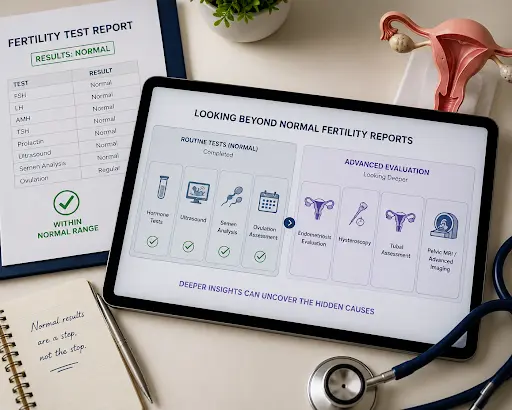
Normal fertility reports do not mean your journey has reached a dead end. A personalised assessment by an experienced fertility specialist can identify overlooked factors, recommend additional investigations where appropriate, and develop evidence-based unexplained infertility treatment options tailored to your individual circumstances.
Every fertility journey is unique. Depending on your history and findings, your doctor may recommend lifestyle optimisation, ovulation monitoring, targeted treatment of underlying conditions, minimally invasive procedures, or assisted reproductive techniques when appropriate.
Consult Dr Pallab Roy, a gynaecologist in Kolkata with over 9 years of experience, to determine the most appropriate female infertility treatment options.
People Also Ask
What percentage of infertility cases are truly unexplained?
Approximately 10-15% of infertile couples receive a diagnosis of unexplained infertility causes after routine investigations fail to identify a clear medical explanation.
Can endometriosis be present even if the ultrasound is normal?
Yes. Mild or early endometriosis may not appear on ultrasound. Diagnostic laparoscopy is sometimes required when clinical suspicion remains high.
What is the next step after being diagnosed with unexplained infertility?
The next step depends on your age, fertility history, and overall health. Your doctor may recommend additional investigations, ovulation monitoring, lifestyle changes, or personalised unexplained infertility treatment options before considering assisted reproductive techniques.
Can stress or lifestyle cause “normal test” infertility?
Stress alone rarely causes infertility, but smoking, obesity, poor nutrition, alcohol misuse, and chronic stress may reduce fertility and should be addressed alongside medical evaluation.
Is IVF necessary for unexplained infertility, or are there other options first?
Not always. Many couples benefit from lifestyle optimisation, ovulation induction, timed intercourse, intrauterine insemination (IUI), or treatment of underlying conditions before IVF is considered.
How long should we try before seeking advanced fertility testing?
Generally, couples under 35 should seek evaluation after one year of trying, while women aged 35 years or older should consult a specialist after six months.
Can hidden infections cause infertility despite normal test results?
Yes. Certain chronic pelvic infections or inflammation may affect fertility even when routine investigations appear normal, although additional evaluation is required to confirm this.
Does age affect unexplained infertility diagnosis and treatment?
Yes. Female fertility naturally declines with age, so treatment decisions and investigation strategies become increasingly time-sensitive after the age of 35.